

Greek Alphabet
Introduction
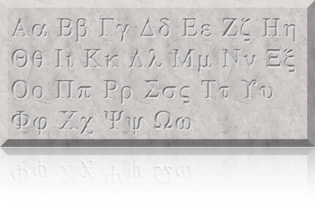
The letters in the Greek alphabet presented below are used for printed Ancient Greek texts. The earliest Greek texts that have survived were written with a radically different script called Linear B.
For a detailed and wonderfully well argued discussion of the origins of the Greek alphabet, see Roger D. Woodard’s book, Greek Writing from Knossos to Homer.
Pronounciation Aids
This site provides three sets of pronunciation suggestions: first the pronunciation of each letter in Modern Greek, then the reconstructed Hellenistic Koine pronunciation, and finally the reconstructed pronunciation for the Classical period (before about 350 BCE). As far as possible, sound clips have been provided for all three periods.
The traditional Erasmian pronunciation used in many schools to teach Biblical Greek and sometimes Classical Greek is not given on this site. It is omitted because it does not accurately reflect the actual pronunciation of the language at any point in its history. While it can be valuable for learning to spell some ancient Greek words, it has no real value in learning how Ancient Greek was actually pronounced.
In the examples, consonants are pronounced accompanied by the vowel /ɑ/ for context.
Learn the alphabet with Hellenistic Greek Pronunciation
The following 10 minute by Tim McNinch will teach you the Greek alphabet using Hellenistic Greek pronunciation. It does not cover the diphthongs presented above, but does a great job of teaching all of the individual letters.
Diphthongs and Digraphs
A diphthong is a combination of two vowel sounds, gliding from one to the other, as the oy in boy. A digraph is a single sound represented by two letters like the th in think.
Choose any diphthong or digraph from the list below to learn how it is pronounced in Modern Greek and how it was pronounced in the Classical and Hellenistic periods.
Practice the Diphthongs from the Hellenistic Period
With just a little practice you can master the diphthongs as they were pronounced in the Hellenistic Period. This video by Tim McNinch can help.
More on Pronunciation
To hear examples of Classical Greek texts read with the reconstructed pronunciation system, visit the Classical Greek Pronunciation page of the Commission for Ancient Literature and Latin Tradition.
For a great demonstration of the pronunciation of Modern Greek, see Harry Foundalis' discussion of the Greek Alphabet. He confuses the Erasimian pronunciation with the reconstructed pronunciation of Classical Greek, but his audio demonstrations of Modern Greek pronunciation are extremely valuable.
Carl Conrad has provided a fine discussion of the history of Ancient Greek pronunciation by, tracing its development from Indo-european. (Clicking the link will download a PDF file.)
Books on the Greek Alphabet
Roger D. Woodard's book, Greek Writing from Knossos to Homer: A Linguistic Interpretation of the Origin of the Greek Alphabet and the Continuity of Ancient Greek Literacy
In Homer and the Origin of the Greek Alphabet
Other Websites that Display the Greek Alphabet
There are many other sites on the internet that show the Greek alphabet. Here are some that provide particularly useful information:
- AncientScripts.com has a very nice discussion of the variations in the script by dialect and some of the changes from ancient to modern times.
- The Omniglot site includes a helpful discussion of the Greek alphabet with pronunciation suggestions.
- AncientGreek.org Pronunciation Guide provides great Attic Greek audio samples for each letter.
- The English Wikipedia Greek Alphabet page has sound samples for Classical and Modern Greek. Unfortunately, it subsumes all of Ancient Greek under a single heading, so does not adequately distinguish between Attic and Hellenistic pronunciations.